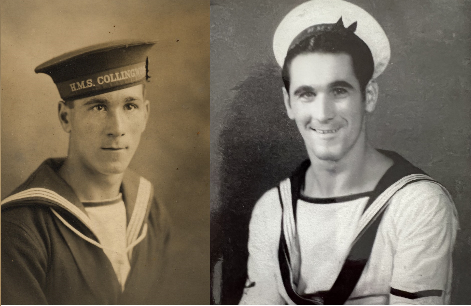
Andrew Ferreira — remembered by his daughter Bunny
“What I do know is that he told me he will never forget my daughter’s date of birth being the
9th April, and that it was a sunny day — as when he went down there were bodies everywhere, and the
sun was shining through the water which helped him get to the surface. (I also knew that there were 13 or
14 survivors.)”
— Bunny Ferreira, on her father Andrew “Bill” Ferreira
Alexander Huskie — remembered by his nephew Stewart Fraser
“Mum recalls vague tales of him being sunk off the coast of Ceylon, making it to shore and trekking
through the jungle through leech-infested swamps with his fellow survivors to relative safety.”
— Stewart Fraser, 2023, on his great-uncle Alexander Huskie
Eric Norman Danby
Pulled out of the sea unconscious. He came to back in hospital in Trincomalee with severe concussion,
including memory loss. He did regain much of his lost memory, but not the sinking. Also served on
HMS Bluebell and HMS Pursuer, and was on the beach at Dunkirk as part of a small RN
medical contingent landed to assist the evacuation. Mentioned in Despatches in 1946.
(Info courtesy of Malcom Perks, 2019.)
The Knott Diary
Unearthed in a ledger from 1765 we found an extraordinarily poignant description written by Dudley
Knott of his wartime experience 1942/5 — found by his daughters Caroline and Amanda in a leather-bound
accounts ledger titled ‘cash received and paid in 1765’ from cousin Lucy of Stratton Park
and the Barnett estate. Kindly supplied by Ian’s grandson, Charles Windisch-Graetz.
“Having survived by the nearest good fortune a singularly unpleasant incident in the Bay of Bengal
whereon, April 9th, 1942, the Flower Class Corvette in which I was serving was completely destroyed by
Japanese dive bombers…”
— Dudley I. C. Knott
“It was with considerable despondency, almost despair, that I learnt of my appointment as First
Lieutenant to a trawler bound for the Persian Gulf Station, to date from April 19th. The ten days’
interval had been fully occupied first in sailing a lifeboat belonging to the oil tanker British Sergeant
(actually this was the Athelstane) — also a Japanese victim — which had picked up
myself and my fellow ten survivors to a deserted and jungle-fringed beach just south of Batticaloa, and
then in trekking inland to a medical missionary who tended our sick and wounded and helped us to remove
most of the oil fuel with which we were contaminated.”
“News of the disaster, for there were six ships involved altogether including an Aircraft Carrier,
percolated through the local planter population who arrived with clothes and comforts. The sarong in
which the good missionary had covered my almost complete nakedness — a sarong carrying the
unfortunate label ‘Made in Japan’ — was reinforced by a very beautiful silk shirt only
a few sizes too big for me (and labelled ‘Made in Italy’), and a pair of large brown shoes
with no laces and a vacant stare about the toecaps.”
“An ambulance train was ordered and from Batticaloa we steamed across country to Colombo. Arriving
at about 2.0 am, a fellow Corvette officer and myself were hurried to St. Mary’s. Unfortunately the
driver assumed, quite naturally, that the military hospital of that name was our destination, but being
accused of being drunk and disorderly by a startled night sister on our arrival, it occurred to us that
perhaps St. Mary’s the Officers’ mess was more the order of the day. However, hospital
routine being what it is, we couldn’t leave until we had been officially discharged by the MD next
morning. Eventually, still in sarong and shirt and brown shoes, I made my report to the Naval Offices and
was given £10 to kit myself up — and a fortnight’s leave in the hills.”
“My journey to Diatalawa was by an extraordinary and quite self-chosen route. I flew in a Swordfish
piloted by a friend in the Naval Air Arm from Colombo racecourse to Trincomalee. Morbid curiosity inspired
me, for we had left Trinco the evening before the sinking, to escape, ironically enough, the air raid with
which the harbour was threatened and which as it turned out was very severe…”
“Back in Colombo next day I discovered the worst — a converted Norwegian whaler fitted out as
an L.L. minesweeping trawler bound for the Persian Gulf. I tried, in vain, to have the appointment
reconsidered, but tiffin and siestas and such uninterruptable events came between me and the
Atmosphere’s sailing which was virtually immediate… And so we sailed, I as First
Lieutenant and Jack Falwasser, a Lieutenant RNR, as Captain: it was six months since I had left Greenock
in the Hollyhock; it was to be over two years more before a Dakota landed me at Hendon almost on the
event of D-Day.”
The full diary continues with a detailed description of the converted whaler ‘Atmosphere’
(originally COS XI), once used for harpooning whales in the Antarctic, and her tour of the Persian Gulf
Station.